
Welcome to the Division of General Dentistry, Faculty of Dental Medicine, Hokkaido University. We provide a seamless and advanced dental education program that integrates undergraduate education, postgraduate clinical training, and graduate-level education. Our mission is to cultivate well-rounded “Super General Dentists” who possess a broad foundation of dental knowledge together with advanced clinical competence. Our section actively promotes cutting-edge dental and medical research, with a strong emphasis on industry–academia collaboration and translational research, aiming to foster the next generation of clinician–scientists in dentistry. In addition, we play a leading role in advancing the Dental Innovation Project within the Faculty of Dental Medicine. In close collaboration with the Clinical Training Center at Hokkaido University Hospital, we remain firmly committed to the continuous advancement of excellence in clinical dental education.
Staff
| Professor | Hirofumi MIYAJI |
| Associate Professor | Yuichiro MATSUI |
| Lecturer | Shunji IIDA |
| Lecturer | Noriyuki TAKASHI |
| Lecturer | Saki MIKAMI |
| Assistant Professor | Erika NISHIDA |
| Assistant Professor | Kanako SHITOMI |
Research
Functionalization of the root surface using laser-assisted biomimetic processes
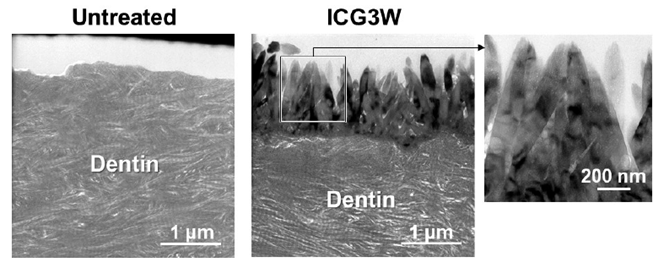
Our joint research team, in collaboration with the Oyane Group at the Nanomaterials Research Institute of National Institute of Advanced Industrial Science and Technology (AIST), is investigating a novel approach to rapidly induce apatite precipitation on tooth surfaces by integrating laser irradiation with biomimetic processes, thereby achieving biofunctionalized tooth surfaces. The apatite layer formed on the tooth surface is capable of encapsulating bioactive molecules and/or antimicrobial agents, suggesting promising applications in the prevention of root caries and the treatment of periodontal disease. Furthermore, this technique is not limited to dental hard tissues and can be extended to various biomaterial surfaces, enabling functional modification of artificial materials such as dental composite resins.
Antibacterial photodynamic therapy using nanoconjugates
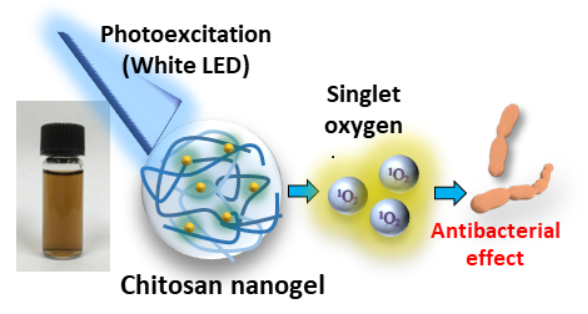
Our joint research team, in collaboration with the Kawasaki Group of the Faculty of Chemistry, Materials and Bioengineering at Kansai University, is developing novel technologies for photodynamic therapy and advancing research on photodynamic disinfection using metal nanoclusters. These nanomaterials are water-soluble and exhibit high biocompatibility. Compared with conventional organic photosensitizers such as methylene blue, they can be photoexcited over a broader wavelength range. Consequently, effective antimicrobial activity can be achieved using commonly available white LED or blue LED dental curing light sources.
Antibacterial calcium phosphate composite particles
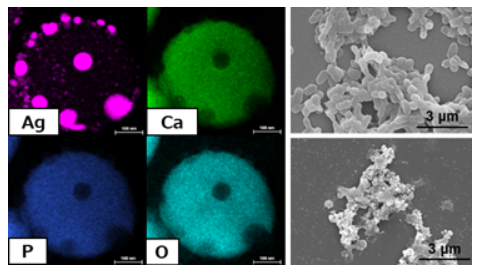
Our joint research team, in collaboration with the Nakamura–Oyane Group at the Nanomaterials Research Institute of National Institute of Advanced Industrial Science and Technology (AIST), has successfully synthesized submicron- and nanoscale calcium phosphate particles incorporating various functional substances and has demonstrated that these particles exhibit antibacterial activity against oral bacteria.
Bioactive glass nanoparticles to prevent and treat periodontal disease and root caries
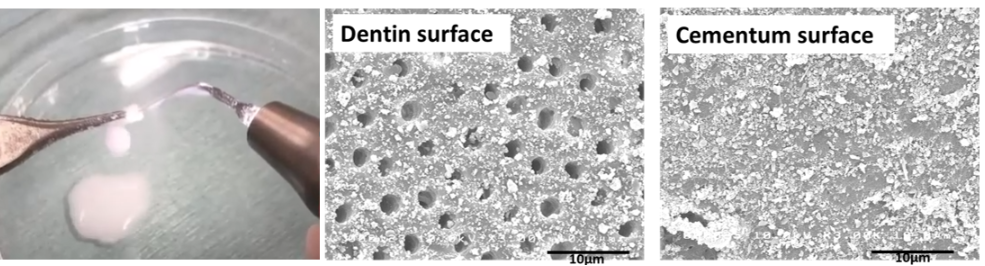
We are conducting research on an innovative tooth-surface coating technology that employs glass nanoparticles capable of releasing bioactive ions, with the aim of enhancing dental treatments for both periodontal disease and dental caries. In this approach, tooth surfaces were uniformly coated with S-PRG (surface pre-reacted glass-ionomer) nanofillers, which release antibacterial ions such as fluoride and borate. When Streptococcus mutans, a major cariogenic bacterium, was inoculated and cultured on the treated tooth surfaces, bacterial growth was effectively inhibited. Furthermore, the S-PRG nanofillers adhered to the tooth surface exhibited sustained release of antibacterial ions over an extended period. In animal models, this sustained ion release was associated with marked improvements in periodontal health. These findings indicate that the S-PRG nanofiller-based coating represents a simple yet highly effective strategy for caries prevention and periodontal therapy, and we are actively advancing its development toward clinical application.
Applying nanocarbon materials to dental medicine
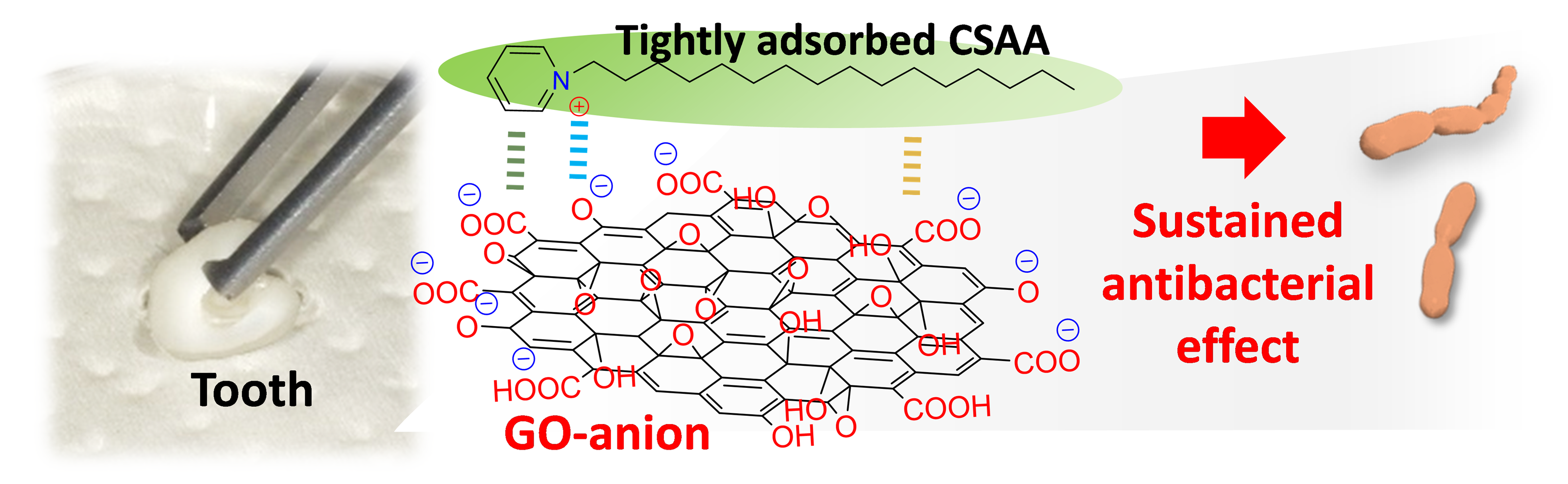
Graphene oxide (GO) is a sheet-like nanocarbon material produced by the strong oxidation and exfoliation of graphite and is known for its remarkable physicochemical properties. The presence of oxygen-containing functional groups on the GO surface enables strong interactions with a wide range of molecules. In collaboration with Nippon Shokubai Co., Ltd., our research team successfully developed a durable, transparent, and water-resistant coating on tooth surfaces using a GO–cetylpyridinium chloride (CPC) complex. Teeth coated with the GO/CPC complex exhibited complete inhibition of bacterial growth. Furthermore, this water-resistant and transparent composite coating is not limited to dental applications and can be applied to various substrates, including glass, plastics, metals, PET, and fabrics. This work represents a novel and versatile application of nanocarbon materials and has attracted considerable attention for its potential in both biomedical and industrial fields.
Development of calcium phosphate–based scaffolds for tissue regeneration
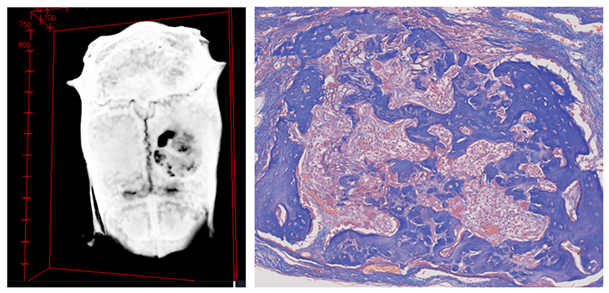
Our research group is developing novel scaffold biomaterials for tissue regeneration by incorporating nanosized calcium phosphate particles into collagen-based matrices. The addition of approximately 100-nm calcium phosphate nanoparticles enhances the bioactivity of collagen scaffolds, promoting cellular and vascular ingrowth and improving regenerative performance. These scaffolds have demonstrated effective bone and periodontal tissue regeneration in animal models, and their regenerative efficacy is further enhanced by combination with fibroblast growth factors. In addition, animal component–free recombinant collagen–based scaffolds incorporating β-tricalcium phosphate nanoparticles show strong potential as safe and effective materials for regenerative dentistry.